Why I Moved From WordPress to Astro in 2026
When all is said and done, the cleanest, most modern, most secure, more affordable, most professionally constructed -and most versatile- website solution for local businesses is an Astro website. I've converted all of my own websites to that setup (some still works in progress), and I would not offer clients what I feel is a second best solution.

Chris Good
Digital Strategist
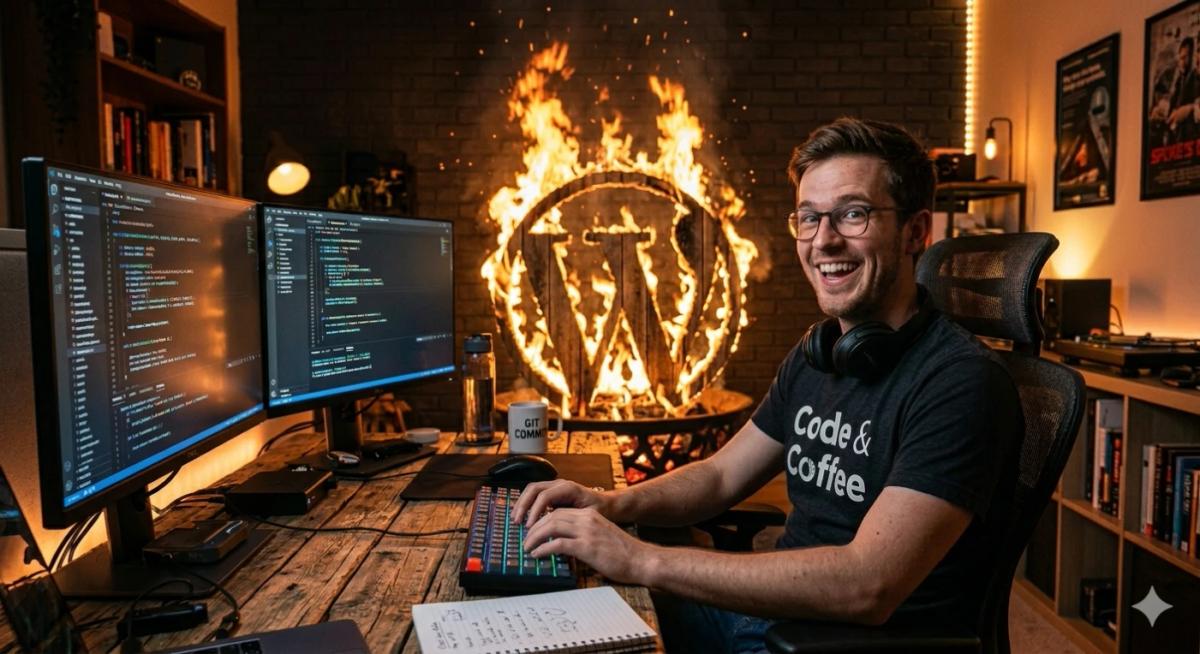
WordPress isn't cooked.
In fact, I'd argue it's better than it's ever been, with a clear move towards developer-focused tools that bring modern frontend development practices to the WordPress ecosystem. Tools such as Oxygen, Bricks and Etch have helped WordPress developers become better developers. We've moved closer to code, embraced components, tokens, variables and modern frontend workflows, and built faster, cleaner websites as a result.
But that raises an uncomfortable question.
If the preparation to be our best selves within WordPress has equipped us to look beyond it, is there still a reason to stay? The irony is that Bricks, Oxygen and Etch may have unintentionally trained a generation of WordPress developers to leave WordPress behind.
Here's how I arrived at that conclusion.
Why Wordpress was on top
I was hand coding my first websites using html, css and javascript when Wordpress was taking its first breaths. It was almost 20 years until I built my first website with the platform which, by that time, was competing with Wix and Squarespace for visual drag and drop dominance; Elementor leading the way.
The SME market was looking for the "affordable or I'll DIY it" quick fixes promised by platforms like Wix, and Wordpress had to compete or die.
And it worked. Wordpress and Elementor became a dominant way to offer websites to the UK SME markets. Freelancers started and established their careers with the tool stack, while web agencies explicitly called for Elementor 'developers' in their Indeed ads.
Unless you were working on more custom projects beyond the realm of general SME websites, Front End Web Development didn't have a place in that era.
Wordpress became the dominant 'custom website' offering because it took care of so much of the backend while, at the same time, providing a range of easy to add but advanced functionality with a plugin ecosystem.
For the clients who wanted more than a DIY Wix presence, devs and agencies could offer Wordpress as an affordable 'custom' website with the ability to skin the thing up using visual drag and drop builders. For better or worse (usually worse) the client could even edit their own site and add pages after handover.
There were other systems out there, for sure: Wix, Squarespace, Shopify, eventually Webflow, but they offered limited functionality, from design to SEO, and used blatant platform lock-in and price hikes.
Wordpress won for features and the freedom.
And then...the wind changed.
Wordpress saw more developer-focused builders starting to edge their way into the market, with Oxygen in 2016 and Bricks in 2021 - due to drawbacks of visual drag and drop systems. Despite coming from more of a coding background, I missed that turn of the tide because I had just left Joomla! behind and turned towards Wordpress, finding the dominating tutorials promoting the use of Elementor. Truth be told, I thought that's what Wordpress was. I was late to the party that everyone was already getting sick of.
Bloated page builders, such as Elementor, had made it easy to haphazardly slap a site together and pocket the cash. I, myself, created a 5-star rated "no-coding" web design course that sold well on Udemy. Flying around the easy interface and splatting elements here and there in a creative whim...it was never so easy to put a page together; I forgot how to code, for the most part.
However, the alternative -and not so youtube dominant- developer community were getting closer to the code with Oxygen and Bricks; a strong community were determined to bend Wordpress to their will, making better use of the CMS while focusing on better web development principles that would mimic a hand coded effort.
It's important to remember that the aim of these developers (and the more complex developer focused builders) was not just to make nerds cool again; it wasn't "just to do it".
The aim was to build lean and to build strong; the mission was to avoid the increasingly obvious downside of visual page builders that was beginning to become obvious in website builds and against ever demanding search engine ranking factors and pagespeed scores. The drag and drop page builders came with a price:
- the heavy DOM,
- page bloat
- hours of click, click, click 'copy and paste' design revisions (that could only increase time spent by agencies and money spent by clients).
Instead of being content to use Drag and Drop Visual Builders to compete with the ease of low-grade, no-code, non-professional tools like Wix, a significant portion of the Wordpress community have been embracing a code first, lean, best web dev principle approach to website development...while still embracing the powerful and familiar Wordpress platform and ecosystem. The best of both worlds.
Front End Web Development Came Back Within Wordpress
In my view, this can't move any further in the Wordpress ecosystem than what we're seeing with Etch builder. The interface literally strips the build experience down to html, css and javascript.
A simple interface assists with adding elements to the page and furnishing them with essential semantic tags, selector classes and full control over the construction of your document.
An Etch built Wordpress website comes in with absolutely zero page bloat, hidden divs or random behaviours caused by page builder shortcuts.
However, the developer has to know their code and be competent in creating variables and relating those correctly to tokenised design systems. The developer needs to observe a component first workflow, with which to construct the website in its entirety. This is best practice in professionally developed web projects.
The result is lean, snappy, more easily updated and a truly professional result.
Etch is absolutely phenomenal for Wordpress. True Front End Web Development is back; and it's compatible with the most powerful and readily available CMS, with its ready ecosystem of plugins and functionality.
Again...the wind changed. This time, WordPress wasn't ready.
AI took the world by storm. AI offered another round of quick and easy wins at a fraction of the price, similar to when Wix blasted into the scene and made fast-fix business owners question whey they need a web developer to build them a site they 'could make themselves'. AI, AI....A-flippin'I.
But AI is not actually the problem for Wordpress.
Wordpress will integrate AI, get on the trend train, and carry on with what it's doing.
The problem is...empowerment.
Like many folks, in any industry, I found myself in a bubble of tools and habits and perspectives. I had become rooted in a worldview and system that I'd gotten comfortable in. When I started using Wordpress, it was when business clients wanted 'something like Wix' and it genuinely seemed to be the best option.
I forgot to challenge that view since that time. I forgot to look around. While I progressed my learning in Wordpress development and web design and digital strategy, I neglected to really look around and find out what else was out there.
AI simply brought the changes to my door. AI caused a flurry of LinkedIn posts that called Wordpress 'cooked' and brought my attention to something new. Vibe coding with AI became the trend, the rage...the threat. Vibe coding uses Jamstack...what the hell is Jamstack?
Jamstack is a modern way of combining very familiar technologies: JavaScript, APIs and Markup. And it is phenomenal. I'll go deeper into the details another time, but for now we just need to know that I vibe coded a website, was exposed to a new tech stack and realised that everything I knew...was wrong.
Here is my new perspective.
Wordpress is not the most powerful CMS
If an argument for Wordpress is that it is the most powerful and readily available CMS, it is a weak argument. It is a good CMS. However, in my first look outside the Wordpress bubble, I've found CMS solutions such as Sanity that integrate with modern frontend frameworks -such as Astro- in a way that feels significantly cleaner and more flexible than WordPress. I have already met a much improved experience for content management that not only performs better, it has more out of the box features, integrates perfectly with other tech and looks and feels modern, sexy and...not "Wordpress Gutenberg" (which is the best argument for using it...ever). Added to that, I recently integrated an Astro website with Shopify in under 15 minutes; the setup was easier than using Wordpress and Woocommerce and has all the benefits of Shopify in ecommerce.
I am now using a better CMS to manage my content on my website and for this very article; it's a subjective stance, but one I can objectively justify both to myself and to my clients. I will offer to them what I would choose for myself. And it's not Wordpress.
The plugin ecosystem is the very problem we need to avoid
If an argument for Wordpress is that it offers a ready ecosystem of plugins that easily add extensive functionality, it is a weak argument.
Any decent Wordpress developer prides themselves on using the fewest plugins possible, lest they encounter conflicts and complications related to a Jenga-like concoction of cobbled together intention.
One builder with the most functionality possible to create brochure websites, and keep everything else as minimal as possible, is the choice of the better Wordpress developers.
However, clients or marketing teams add plugins on a whim. These plugins clog up the site when a developer could have added one line of code in the head section. Plugins drain resources and slow the site and leave residuals in the database when they're finally removed.
Even when locking a website down from client admins, the plugins age. The builders age. Replacements and overhauls are required. Clients don't like that...it costs money and time...and arguments: "I thought you said this setup was 'cutting edge' and now I need to replace it?" said the disgruntled (and correct) Wordpress client. Even those who entrusted their new faith in the previously mentioned Etch builder for Wordpress now have to face the fact that the company has changed focus to non-Wordpress.
For the vast majority of SME business brochure websites, aside from bringing in something like a Calendly widget, most of the site can actually be created with HTML, CSS and Javascript that is not challenging to even a half-competent front end web developer.
The reliance on page builders that age and die, leaving you with content trapped in the old carcass and the necessity of a rebuild, is only for the supposed advantage of dragging and dropping during the web design process. Guess what? It's usually the web dev doing that part...so why lock into a mess of a builder, instead of creating with a fundamental skillset? It's actually better for the client.
Still...people love an 'ecosystem' of quick fixes.
The fact that people don't consider is that if it does go wrong (or 'when' is more appropriate for tech) it is actually simpler to fix pure code yourself, or bring in a capable coder, than submit a ticket to a mysterious plugin developer and hope they might sign into your site with full admin access and tinker under the hood to gaffer tape a solution together within the confines of mass market code base that can't entirely be disturbed.
Clean code outlasts systems. Clean code can survive on a static server in the way a php tangled database can't.
Wordpress client editing is not the best on offer
If an argument for Wordpress is that it offers tools for page creation and editing that proves convenient for clients and non-web marketing teams to use, it is a weak argument.
Wordpress admin functions and user content management are notoriously tangled and horrendously outdated in how they look in the interface and, also, in how they behave in filtering or sorting options.
Unless a Wordpress website is built using Bricks, Etch or possibly Oxygen, with component-focused development, a non-technical user of the website will need to wrestle with page builder mechanics, oddly half-locked down builder segments and awkward templates.
My first batch of websites built with Sanity and Next or Sanity and Astro have not only required no databases and related vulnerabilities, but the clients can sign into a sleek interface, with only the content on view, and use an easy to use drag and drop builder to build pages using existing components.
Because I have built with client editing and marketing team page development in mind, the content management system is sleek, smooth, powerful, separate from administration functions and...dammit, it looks great. I cannot describe Wordpress with any of those words.
Wordpress does not offer the most affordable or effective builder experience
With the development of Oxygen, Bricks and Etch, we've seen the more 'developer-minded' and, in truth, 'web professional' developers put their fingers back to the keyboards and sharpen their skillset in true Front End Web Development.
The advantages of this more professional approach are:
- More scalable builds
- Sites with easier editing, even for full brand changes
- Faster websites with less overheads on code
- Improved page speed and SEO ranking
- More affordable fees for clients, with fewer technical issues, updates and reduced hours on further work or revisions.
- & more!
For years, the need to make use of the Wordpress CMS system with its ease of availability and feature-full ecosystem meant using the horror that is Gutenberg, the awkward likes of WP Bakery or the Page speed murdering, bloated builders like Elementor.
Whatever approach was used, in order to maintain use of Wordpress, the role of the true coding Front End Web Developer had vanished in favour of a Click and Collect type of page building we've called "Web Development" for far too long.
If we can convince clients and agencies to use these more developer focused tools, we can use better web development practice -with all its benefits- within Wordpress.
This is the real benefit of that developer movement with tools such as Oxygen, Bricks and Etch.
But that's the problem...
Is there a reason to remain with Wordpress?
Well, like I say, Wordpress isn't dead...it's not cooked...it still has a very relevant place in website design for SMEs. Although I have just mentioned the easy integration of Shopify with an Astro build, there is still a case for using a Wordpress setup for more complex websites that require ecommerce and membership. If I needed a complex membership site tomorrow, WordPress would still be high on my shortlist.
Now that a significant portion of the Wordpress developer community have bought Oxygen, Bricks and Etch and sharpened up their coding skills, myself included, the world has just opened up once again!
The preparation to be our best selves within Wordpress has equipped us to look beyond it. It has empowered us to explore further. The irony is that Bricks, Oxygen and Etch may have unintentionally trained a generation of WordPress developers to leave WordPress behind.
Working in VS Code or FEWD Studio again is familiar -and fun. Building pages from scratch with the clackity clack of the keyboard in the air provides a true feeling of being a developer thriving in a professional environment. Seeing the code carve onto the page and build a real-time server preview of the page or component is...exciting.
Knitting the client's brand into a coded design system with variables and tokens feels (because it is) professional and fulfilling.
Taking a designer's web page visual -approved by the client- and using a simple code editor to sculpt pixel-perfect and branded component building blocks for website pages is a journey of discovery and solutions and rewarding skill.
But....we don't need to do this in Wordpress.
Wordpress is not the best CMS out there, for the developer or the client.
Wordpress does not offer a robust and reliable ecosystem of incredible plugins. In truth, it's a large repository dominated by a few big hitters...the functionality of them is largely unnecessary outside of Wordpress, or seldom used.
Wordpress is not something you need any longer.
The Jamstack Solution with Astro and FEWD Studio
Personally, as I have re-engaged with the coding fundamentals and become more competent with a frontend skillset, it has been impossible to remain satisfied with the lack of control and the ever-present level of risk that presents with a Wordpress setup.
Even more than that, the simple fact is that creating a project with even my favourite builder in Wordpress (Bricks), there is no real feeling of advantage of that over an Astro development.
When all is said and done, the cleanest, most modern, most secure, more affordable, most professionally constructed -and most versatile- website solution for local businesses is an Astro website. I've converted all of my own websites to that setup (some still works in progress), and I would not offer clients what I feel is a second best solution.
How do you feel about it?
If you'd like to learn more about building with Astro (and with the dedicated Code Editor, FEWD Studio), then take a look at this video: Is JAMstack back and is Wordpress cooked?
For a visual coding editor right on your desktop, take a look at FEWD Studio.
FEWD Studio also has a companion app: the first desktop CSS Framework generator of its kind, GenCSS
Chris Good
Digital Strategist
Chris Good is a Digital Strategist helping ambitious SME owners build digital systems that generate qualified leads and sustainable revenue growth. Based in Devon, UK.
Book a Consultation